
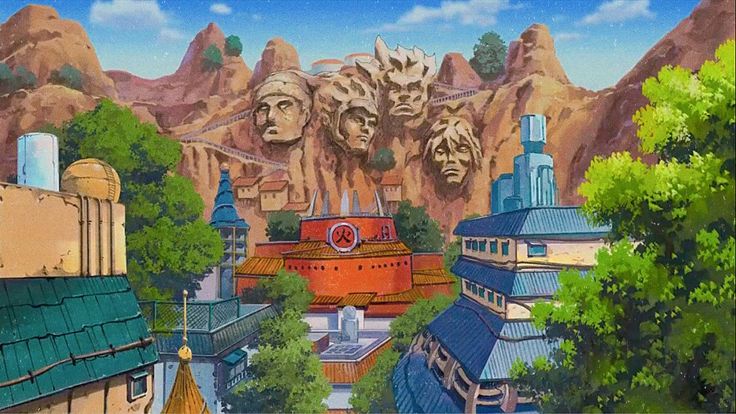
Konoha: The Hidden Leaf Village
Share
1222 mots | Temps de lecture : 6 minute(s)
Konoha , officially called Konohagakure no Sato (木ノ葉隠れの里) , is one of the five great ninja villages of the Naruto universe, imagined by Masashi Kishimoto . Symbol of peace and transmission , this forest village of the Land of Fire is the geopolitical and emotional heart of the saga. It saw the birth of the greatest heroes of ninja history, including Naruto Uzumaki , and has gone through countless trials without ever turning away from its fundamental will: to protect its own at the cost of all sacrifices .
Konoha's Foundation and Ideals
Konoha was born from the historic alliance between the Senju and Uchiha clans, led by Hashirama Senju and Madara Uchiha . Tired of the constant wars between ninja clans, they decided to create a haven of peace where young people could grow up without being weapons. The village was built in the heart of the forests of the Land of Fire, hidden from view, and quickly became a model for other great ninja nations.
The Will of Fire
The Will of Fire , a central philosophy of Konoha, teaches that every ninja has a duty to protect the village like a large family , to pass on their knowledge to future generations, and to place the common good above all else . This ideology is the moral cement of the village, carried by successive Hokage.
The Hokage System
The Hokage (火影) is both a military leader and a father figure in the village. He embodies the spirit of the Will of Fire and makes crucial decisions for the survival and evolution of Konoha.
- 1st: Hashirama Senju – Creator of the village, apostle of peace, manipulator of Mokuton
- 2nd: Tobirama Senju – Organizer, creator of many institutions and techniques
- 3rd: Hiruzen Sarutobi – Experienced Sage, Long Reigning
- 4th: Minato Namikaze – War hero, father of Naruto, died protecting the Kyûbi village
- 5th: Tsunade – Heir to medical knowledge, rebuilt Konoha after Pain's attack
- 6th: Kakashi Hatake – Former ANBU, fine strategist, smooth transition to the era of peace
- 7th: Naruto Uzumaki – Last Jinchûriki, unifier of the ninja world
Organization and internal structures
Konoha is a village structured militarily , politically and economically :
- Ninja Academy – Place where all young aspirants (future genin) are trained
- Konoha Council – Civilian and military leaders, sometimes including influential former clans
- ANBU – Special unit operating in the shadows (assassinations, reconnaissance, close protection)
- Police Force – Formerly led by the Uchiha clan before their fall
- Medical Corps – Trained by Tsunade, specializing in surgery and medical ninjutsu
Ninja teams are structured into cells of three genin , supervised by an experienced jônin (like Kakashi or Asuma).
The prestigious clans of Konoha
The village is known for its many founding clans and heirs:
- Uchiha – Kekkei Genkai: Sharingan. Powerful fire and illusion techniques. Tragedy: Massacre by Itachi.
- Hyûga – Byakugan and soft fist. Clan divided into main and secondary branches.
- Nara – Shadow Manipulation, Brilliant Strategists (Shikamaru).
- Akimichi – Expansion techniques. Physical strength and solidarity.
- Yamanaka – Mind transmission and espionage. Often in tandem with Nara and Akimichi.
- Aburame – Symbiosis with insects, useful in infiltration.
- Inuzuka – Fight with ninja dogs. Perfect combination of flair, speed, and raw power.
- Sarutobi – Clan of the 3rd Hokage. Known for their tenacity, moral strength, and versatility.
Internal conflicts
Konoha has not always been a model of unity: the treatment reserved for the Uchiha clan , the marginalization of Jinchûriki like Naruto or the social pressure exerted on the secondary clans of the Hyûga clan show the flaws of a system based on inheritance. These internal conflicts are sometimes at the origin of revolts or major betrayals , like that of Orochimaru or Sasuke.
Heritage, architecture and culture
Konoha has traditional architecture mixed with modern touches (most notably seen in Boruto ). The village is organized around Mount Hokage , where the faces of successive leaders are carved.
Emblematic sites:
- Ichiraku Ramen – Naruto's Favorite Restaurant
- The Hokage Tower – Konoha's political nerve center
- The Uchiha Quarter – Abandoned after their massacre
- Training Ground 7 – Team Kakashi's iconic training ground
Konoha in ninja history
Konoha is at the center of many major events in the saga:
- Obito attacks the Kyûbi , decimating the village and killing Minato
- Orochimaru's Invasion – Death of the Third Hokage, start of the Second Great Crisis
- Destruction by Pain – Then resurrection of the village thanks to Nagato
- Participation in the 4th Great Ninja War – Konoha plays a leading role in the shinobi alliance
Konoha in the era of Boruto
Under the leadership of Naruto Hokage , Konoha underwent rapid modernization :
- Advanced technologies – Scientific weapons, electrical infrastructure, networks, high-speed rail
- New Generation – Boruto, Sarada, Mitsuki… trained in a more modern school but faithful to the old Academy
- Fragile Balance – Threats from the Kara organization, generational conflicts, technological temptation
The village now embodies the bridge between tradition and progress . Naruto ensures this, but the challenges continue to grow in a rapidly changing world.
Why is Konoha an iconic place?
- Cradle of heroes : Naruto, Sasuke, Kakashi, Tsunade, Shikamaru…
- Moral and political heart of the ninja world
- Reflecting the manga's history : each major arc has an impact on its evolution
- Living place : bearer of hope, wounds and resilience
Conclusion
Konoha , the Hidden Leaf Village , is much more than a setting. It is the silent but central character of the Naruto universe, carrying the ideals of peace , transmission , responsibility and evolution . From its bloody foundations to its technological rise in Boruto , Konoha embodies the eternal struggle between shadow and light , between the weight of the past and the hope of future generations .